Graphic Design
The aim of the Graphic Design course at the Rietveld is to develop a students understanding of the role, desires and possibilities of design, towards (independent) practice. The department focuses on teaching students how to organise and shape information within today’s social and cultural context, based on knowledge of the history of design and with an emphasis on the role played by conceptual and editorial approaches to it.
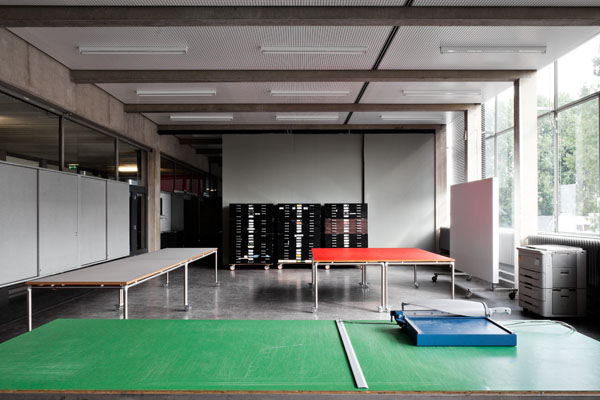
For graphic assignments contact <buro[at]rietveldacademie.nl>,
more information about: work with our students
In the Graphic Design course you will learn how to address and analyse a question or issue and adopt your own stance towards it. Our course teaches you how to take a critical approach to content and to take responsibility for your chosen points of departure, meanwhile teaching you to give form to your ideas. Developing a personal, autonomous and curious approach to design practice is a crucial aspect of our programme. To begin to understand and focus more closely on any personal preferences you might have – by means of critical reflection – you can begin to make conscious and effective use of images and text. In the department you will have extensive opportunities to learn new techniques and have access to a range of relevant and recent media. The department encourages discussion and debate and provides a context for this by teaching relevant theories from the humanities (art, media, philosophy and semiotics, etc.).
Towards graduation, the course aims to educate designers who can contribute to the development of the discipline, are prepared to use their work to engage in debate, adopt an investigative and reflective approach to media, and can express themselves in their own specific design language.
Courses offered
Four courses are offered across all year groups, supplemented by workshops and lessons in technique. The four courses are: Design, Image, Typography and Theory. Teachers devise short or long-term projects within each course and compile study materials based on these projects. The courses are further subdivided as follows: Design – graphic design, editorial design, interactive design. Image – photography, video and film, drawing; Typography – typographical design, letter design; Theory – design history, media theory, writing. Technique is also taught alongside the courses, including digital techniques, offset printing, silkscreen printing, book binding, letterpress, laser cutting, plot printing, etc. The content of the courses will be different in each separate year of your programme. In addition, the detailed course content will depend on the member of academic teaching staff who will apply their own vision, practical experience and interests in their teaching. All teachers in the department are actively practicing designers, artists, curators or theorists.
Study structure
First specialisation year
The first year is primarily an introduction to the subject area and focuses on learning about a range of different media.
Second specialisation year
In the second specialisation year you will investigate the subjects and media more deeply and in more detail.
Third specialisation year
The third specialisation year is dominated by the final examination and applied assignments, beginning with a six week residency outside of Amsterdam. For the final examination, students can decide the direction of their studies for themselves, culminating in a thesis and own projects. Applied assignments are ‘real’ assignments, producing graphic design for both internal and external school projects. The final examination exhibition is held in June of each year and is open to the public.
Applied assignments
The Graphic Design department is actively involved in a number of academy-wide projects, including: Open Day, Rietveld UnCut, Studium Generale, Fashion Show, and the annual exhibition in the old church. These projects require graphic design for communication and are assigned to an individual student or a small group. The student[s] work in close dialogue with the commissioner and under guidance from teachers in the department.
Workshops and guest lectures
Each class will have two one week workshops, from invited guests, per semester. A number of guest lectures, open to all students, also punctuate each semester. The invited guests come (but not exclusively) from both design and art contexts.

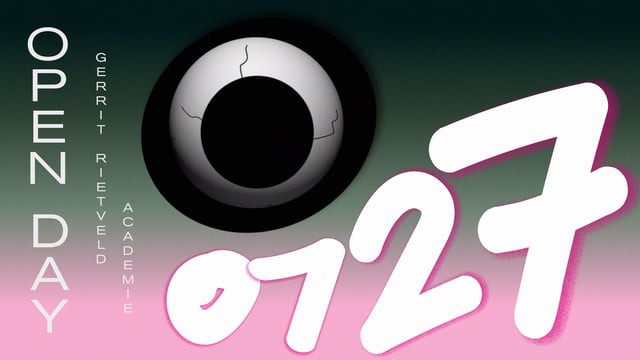
Open Day 2017
Read more
"Starting from a literal association we had towards the Open Day which would be “how to open something?” or 'to open up a fizzy drink with a bottle opener' we started to use the inside shape of an opener and eventually turned it into an eye - after all, that’s how we experience the Rietveld Academie, as a space open for everyone and every kind of idea, as well as an eye-opener!"
Bernadeta Rimutyte, Melisa Zaimovic, Rodrigo Vasquez Callo, Victoria Langmann
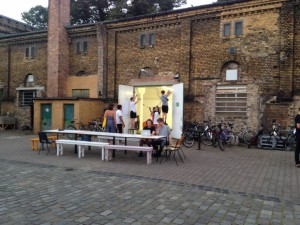
Wendy36: Rietveld in Berlin
Read more
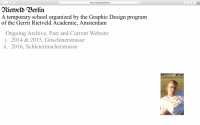
For a period of six weeks a group of third year Graphic Design students from the Gerrit Rietveld Academie Amsterdam, together with Calla Henkel, Max Pitegoff & Emily Segal, have been creating, exploring, maintaining, and transforming their workspace in Berlin.
And now, they're inviting you to join them on 14 October - 7PM
Wendy36
Schleiermacherstraße 36, 10961 Berlijn
14 October - 7PM
Students 1st year
Students 2nd year
Students 3rd year